- 40033332222
- 819698405@qq.com
- 周一至周五 9:00-18:00



制造商:: -
Product datasheet: Sensirion_Humidity_Sensors_SHT3x_Datasheet_digital.pdf
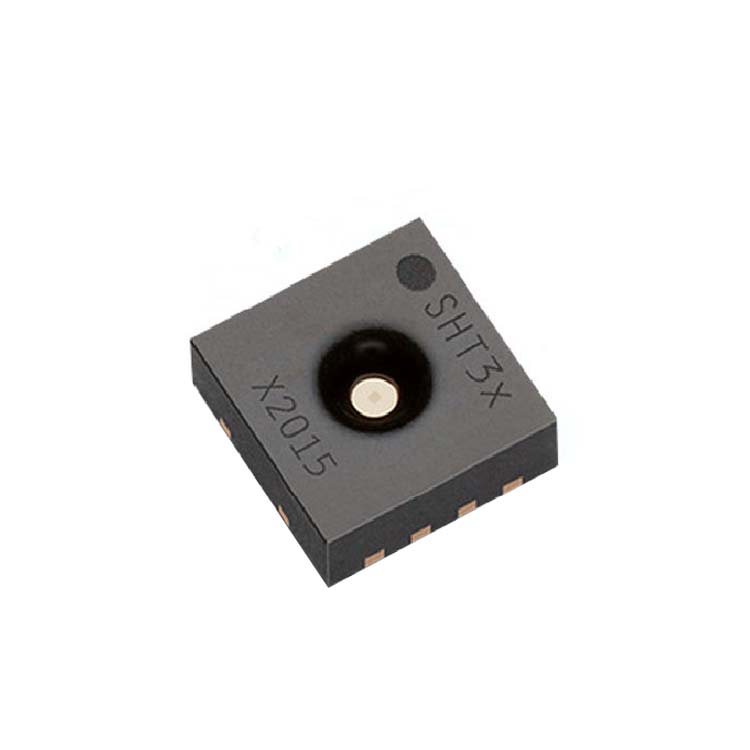
Digital humidity & temperature sensor — specification summary
Humidity and Temperature Sensor
compensated digital output
MHz and two user selectable addresses
nRESET
RH Sensor T Sensor
Power on Reset
Calibration Memory
Data processing & Linearization
1 Sensor Performance............................................. 2
2 Specifications ....................................................... 6
Alert Logic
Digital Interface
3 Pin Assignment .................................................... 8
4 Operation and Communication ............................. 9
Alert SDA SCL ADDR
5 Packaging ........................................................... 16
6 Shipping Package .............................................. 18
Specified range 3 extended 4 0 to 100 %RH
Response time 5 63% 8 6 s
Long-term drift Typ. 7 <0.25 %RH/yr
Table 1 Humidity sensor specification.
SHT30 Accuracy tolerance 1
SHT35 Accuracy tolerance 1
Long Term Drift max <0.03 °C/yr
Table 2 Temperature sensor specification.
maximal tolerance typical tolerance
Relative Humidity (%RH) SHT35
Figure 4 Tolerance of RH at 25°C for SHT35.
100 ±4 ±4 ±4 ±4 ±4 ±4 ±4 ±4
100 ±2 ±2 ±2 ±2 ±2 ±2 ±2 ±2 ±2
90 ±3 ±3 ±3 ±3 ±3 ±3 ±3 ±3
90 ±2 ±2 ±2 ±2 ±2 ±2 ±2 ±2 ±2
80 ±2 ±2 ±2 ±2 ±2 ±2 ±2 ±2
80 ±2 ±2 ±2 ±2 ±2 ±2 ±2 ±2 ±2
70 ±2 ±2 ±2 ±2 ±2 ±2 ±2 ±2
70 ±2 ±2 ±2 ±2 ±2 ±2 ±2 ±2 ±2
60 ±2 ±2 ±2 ±3 ±2 ±2 ±2 ±2
60 ±2 ±2 ±2 ±2 ±2 ±2 ±2 ±2 ±2
50 ±2 ±2 ±2 ±2 ±2 ±2 ±2 ±2
50 ±2 ±2 ±2 ±2 ±2 ±2 ±2 ±2 ±2
40 ±2 ±2 ±2 ±2 ±2 ±2 ±2 ±2
40 ±2 ±2 ±2 ±2 ±2 ±2 ±2 ±2 ±2
30 ±2 ±2 ±2 ±2 ±2 ±2 ±2 ±2
30 ±2 ±2 ±2 ±2 ±2 ±2 ±2 ±2 ±2
20 ±2 ±2 ±2 ±2 ±2 ±2 ±2 ±2
20 ±2 ±2 ±2 ±2 ±2 ±2 ±2 ±2 ±2
10 ±3 ±3 ±3 ±3 ±3 ±3 ±3 ±3
10 ±2 ±2 ±2 ±2 ±2 ±2 ±2 ±2 ±2
0 ±4 ±4 ±4 ±4 ±4 ±4 ±4 ±4
0 ±2 ±2 ±2 ±2 ±2 ±2 ±2 ±2 ±2
Temperature (°C)
Figure 5 Typical tolerance of RH over T for SHT30. Figure 6 Typical tolerance of RH over T for SHT31.
70 ±1.5 ±1.5 ±1.5 ±1.5 ±1.5 ±1.5 ±1.5 ±2 ±2
60 ±1.5 ±1.5 ±1.5 ±1.5 ±1.5 ±1.5 ±1.5 ±2 ±2
50 ±1.5 ±1.5 ±1.5 ±1.5 ±1.5 ±1.5 ±1.5 ±2 ±2
40 ±1.5 ±1.5 ±1.5 ±1.5 ±1.5 ±1.5 ±1.5 ±1.5 ±2
30 ±1.5 ±1.5 ±1.5 ±1.5 ±1.5 ±1.5 ±1.5 ±1.5 ±2
20 ±1.5 ±1.5 ±1.5 ±1.5 ±1.5 ±1.5 ±1.5 ±1.5 ±2
10 ±1.5 ±1.5 ±1.5 ±1.5 ±1.5 ±1.5 ±1.5 ±1.5 ±2
0 ±1.5 ±1.5 ±1.5 ±1.5 ±1.5 ±1.5 ±1.5 ±1.5 ±2
Figure 7 Typical tolerance of RH over T for SHT35.
| SHT3x-DIS is the next generation of Sensirion’s | package has a footprint of 2.5 x 2.5 mm | while keeping |
|---|---|---|
| temperature and humidity sensors. It builds on a new | a height of 0.9 mm. This allows for integration of the | |
| CMOSens® sensor chip that is at the heart of Sensirion’s | SHT3x-DIS into a great variety of applications. | |
| new humidity and temperature platform. The SHT3x-DIS | Additionally, the wide supply voltage range of 2.15 V to | |
| has increased intelligence, reliability and improved | 5.5 V guarantees compatibility with diverse assembly | |
| accuracy specifications compared to its predecessor. Its | situations. All in all, the SHT3x-DIS incorporates 15 | |
| functionality includes enhanced signal processing, two | years of knowledge of Sensirion, the leader in the | |
| distinctive and user selectable I2C addresses and | humidity sensor industry. |
| Parameter | Condition | Value | Units |
|---|---|---|---|
| Typ. | 2 | %RH |
| Max. | Figure 2 | - |
|---|---|---|
| Typ. | 2 | %RH |
| Max. | Figure 3 | - |
|---|---|---|
| Typ. | ±1.5 | %RH |
| Max. | Figure 4 | - | ||
|---|---|---|---|---|
| Low, typ. | 0.21 | %RH | ||
| Repeatability | 2 | Medium, typ. | 0.15 | %RH |
| High, typ. | 0.08 | %RH | ||
| Resolution | Typ. | 0.01 | %RH | |
| Hysteresis | at 25°C | %RH | ||
| 0.8 |
| Parameter | Condition | Value | Units | |
|---|---|---|---|---|
| 1 | typ., 0°C to 65°C | 0.2 | °C |
| Max. | Figure 8 | - | |||
|---|---|---|---|---|---|
| SHT31 Accuracy tolerance | 1 | typ., 0°C to 90°C | 0.2 | °C | |
| Max. | Figure 9 | - | |||
| 1 | typ., 20°C to 60°C | ±0.1 | °C |
| Max. | Figure 10 | - | ||
|---|---|---|---|---|
| Low, typ. | 0.15 | °C | ||
| Repeatability | 2 | Medium, typ. | 0.08 | °C |
| High, typ. | 0.04 | °C | ||
| Resolution | Typ. | 0.01 | °C | |
| Specified Range | - | -40 to 125 | °C | |
| Response time | 8 | | >2 | s |
| D RH (%RH) | D RH (%RH) |
|---|---|
| ±8 | ±8 |
| SHT30 | Relative Humidity (%RH) | SHT31 | ||
|---|---|---|---|---|
| Figure 2 | Tolerance of RH at 25°C for SHT30. | Figure 3 | Tolerance of RH at 25°C for SHT31. | |
| D RH (%RH) |
Document Name Description Source
SHT3x Shipping Package Information on Tape, Reel and shipping bags (technical drawing and dimensions) Available upon request
Available for download at the Sensirion humidity sensors download center:
SHTxx_STSxx Assembly of SMD Packages Assembly Guide (Soldering Instructions)
www.sensirion.com/humidity-download
Available for download at the Sensirion humidity sensors download center: www.sensirion.com/humidity-download
SHTxx_STSxx Design Guide Design guidelines for designing SHTxx humidity sensors into applications
SHTxx Handling Instructions Guidelines for proper handling of SHTxx humidity sensors
Sensirion Humidity Sensor Specification Statement Definition of sensor specifications.
Table 24 Documents containing further information relevant for theSHT3x-DIS.
Updated information about data memory to: “After the read out command “fetch data” has been issued, the data memory is reset, i.e. no measurement data is present.
March 2017 4 2-5
Table 3 updated
Table 22 updated
Inlcuded: “Parameter values specified in the datasheet overrule possibly conflicting statements given in references cited in this datasheet.“
Updated VDD min and POR levels
Updated supply current values
Updated specification range
Introduced “After sending a command to the sensor a minimal waiting time of 1ms is needed before another command can be received by the sensor.” In section 4
Removed: “The stop condition is optional.” in section 4.1
Updated label of Table 9 with “The first “SCL free” block indicates a minimal waiting time of 1ms.”
Updated section 4.5 to “Upon reception of the break command the sensor abort the ongoing measurement and enter the single shot mode.”
Updated section 4.8 to “Upon reception of the break command the sensor will abort the ongoing measurement and enter the single shot mode. This takes 1ms.”
Warning, Personal Injury
Do not use this product as safety or emergency stop devices or in any other application where failure of the product could result in personal injury. Do not use this product for applications other than its intended and authorized use. Before installing, handling, using or servicing this product, please consult the data sheet and application notes. Failure to comply with these instructions could result in death or serious injury.
This warranty does not apply to any equipment which has not been installed and used within the specifications recommended by SENSIRION for the intended and proper use of the equipment. EXCEPT FOR THE WARRANTIES EXPRESSLY SET FORTH HEREIN, SENSIRION MAKES NO WARRANTIES, EITHER EXPRESS OR IMPLIED, WITH RESPECT TO THE PRODUCT. ANY AND ALL WARRANTIES, INCLUDING WITHOUT LIMITATION, WARRANTIES OF
If the Buyer shall purchase or use SENSIRION products for any unintended or unauthorized application, Buyer shall defend, indemnify and hold harmless SENSIRION and its officers, employees, subsidiaries, affiliates and distributors against all claims, costs, damages and expenses, and reasonable attorney fees arising out of, directly or indirectly, any claim of personal injury or death associated with such unintended or unauthorized use, even if SENSIRION shall be allegedly negligent with respect to the design or the manufacture of the product.
MERCHANTABILITY OR FITNESS FOR A PARTICULAR PURPOSE, ARE EXPRESSLY EXCLUDED AND DECLINED. SENSIRION is only liable for defects of this product arising under the conditions of operation provided for in the data sheet and proper use of the goods. SENSIRION explicitly disclaims all warranties, express or implied, for any period during which the goods are operated or stored not in accordance with the technical specifications. SENSIRION does not assume any liability arising out of any application or use of any product or circuit and specifically disclaims any and all liability, including without limitation consequential or incidental damages. All operating parameters, including without limitation recommended parameters, must be validated for each customer’s applications by customer’s technical experts. Recommended parameters can and do vary in different applications. SENSIRION reserves the right, without further notice, (i) to change the product specifications and/or the information in this document and (ii) to improve reliability, functions and design of this product. Copyright © 2019, by SENSIRION. CMOSens ® is a trademark of Sensirion All rights reserved
ESD Precautions The inherent design of this component causes it to be sensitive to electrostatic discharge (ESD). To prevent ESD-induced damage and/or degradation, take customary and statutory ESD precautions when handling this product. See application note “ESD, Latchup and EMC” for more information.
Sensirion Inc. USA phone: +1 312 690 5858 info-us@sensirion.com www.sensirion.com Sensirion Japan Co. Ltd. phone: +81 3 3444 4940 info-jp@sensirion.com www.sensirion.co.jp
Sensirion Korea Co. Ltd. phone: +82 31 337 7700~3 info-kr@sensirion.co m www.sensirion.co.kr Sensirion China Co. Ltd. phone: +86 755 8252 1501 info-cn@sensirion.com www.sensirion.com.cn/
fax: +41 44 306 40 30
info@sensirion.com www.sensirion.com
Sensirion Taiwan Co. Ltd. phone: +41 44 306 40 00 info@sensirion.com
To find your local representative, please visit www.sensirion.com /contact
| Date | Version | Page(s) | Changes | ||
|---|---|---|---|---|---|
| October 2015 | 1 | - | |||
| June 2016 | 2 | 2-4 | Specifications for SHT35 added | ||
| 6 | ESD specifications updated | ||||
| 7 | Table 7 | “Comments” section updated | |||
| 7 | Figure 11 | updated according to | Table 7 | ||
| 11 | Updated information about data memory to: “After the read out command |
| 17 | Ordering information in | Table 23 | updated | |||
|---|---|---|---|---|---|---|
| August 2016 | 3 | 6 | Updated | Table 3 | ||
| 7 | Updated | Table 4 | ||||
| 7 | Updated information on ESD testing norm | |||||
| 8 | Updated | Table 7 | ||||
| 8 | Figure 11 | and Table 7 | updated |
| Figure 5 | , Figure 8 | , Figure 9 | and Figure 10 | |
|---|---|---|---|---|
| 9 | Table 8 | updated |
| 8 | Figure 11 | updated |
|---|---|---|
| 15 | Table 21 | updated |
| 18 | Figure 15 | land pattern drawing simplified (no parameter changed) |
|---|---|---|
| 19 | Inlcuded: “Parameter values specified in the datasheet overrule possibly |
| 22 May 2018 | 5 | multiple | VDD min =2.15V | |
|---|---|---|---|---|
| multiple | Typo & formatting correction | |||
| 2 | Updated RH repeatability values in | Table 1 | ||
| 2 | Updated T repeatability and resolution in | Table 2 | ||
| 6 | Table 3 |
| 7 | Updated soft reset time in | Table 4 | |
|---|---|---|---|
| 7 | Introduced | Table 5 | |
| 7 | Introduced “Ratings are only tested each at a time.” in section 2.3 | ||
| 9 | Introduced “After sending a command to the sensor a minimal waiting time |
| 14 | Updated | Table 21 | ||
|---|---|---|---|---|
| February 2019 | 6 | 19 | Revised qualification test method in section 7 |
| SENSIRION within fourteen (14) days after their | Copyright | © 2019, by SENSIRION. |
|---|---|---|
| CMOSens | ® is a trademark of Sensirion |
| SENSIRION AG | Sensirion Inc. USA | Sensirion Korea Co. Ltd. | |
|---|---|---|---|
| Laubisruetistr. 50 | phone: +1 312 690 5858 | phone: +82 31 337 7700~3 | |
| CH-8712 Staefa ZH | info-us@sensirion.com | info-kr@sensirion.co | m |
D T (°C) D T (°C) D T (°C) D T (°C) D T (°C) D T (°C) D T (°C) D T (°C) D T (°C) D T (°C) D T (°C) D T (°C) D T (°C) D T (°C) D T (°C) D T (°C) D T (°C) D T (°C) D T (°C) D T (°C) D T (°C) D T (°C) D T (°C) D T (°C) D T (°C) D T (°C) D T (°C) D T (°C) D T (°C) D T (°C) D T (°C) D T (°C) D T (°C) D T (°C) D T (°C) D T (°C) D T (°C) D T (°C) D T (°C) D T (°C) D T (°C) D T (°C) D T (°C) D T (°C) D T (°C) D T (°C) D T (°C) D T (°C) D T (°C) D T (°C) D T (°C) D T (°C) D T (°C) D T (°C)
±1.5
maximal tolerance
typical tolerance
±1.0
±0.5
±0.0
D T (°C) D T (°C) D T (°C) D T (°C) D T (°C) D T (°C) D T (°C) D T (°C) D T (°C) D T (°C) D T (°C) D T (°C) D T (°C) D T (°C) D T (°C) D T (°C) D T (°C) D T (°C)
Temperature (°C)
Figure 10 Temperature accuracy of the SHT35 sensor.
The sensor shows best performance when operated within recommended normal temperature and humidity range of 5 °C – 60 °C and 20 %RH – 80 %RH, respectively. Long-term exposure to conditions outside normal range, especially at high humidity, may temporarily offset the RH signal (e.g. +3%RH after 60h kept at >80%RH). After returning into the normal temperature and humidity range the sensor will slowly come back to calibration state by itself. Prolonged exposure to extreme conditions may accelerate ageing. To ensure stable operation of the humidity sensor, the conditions described in the document “SHTxx Assembly of SMD Packages”, section “Storage and Handling Instructions” regarding exposure to volatile organic compounds have to be met. Please note as well that this does apply not only to transportation and manufacturing, but also to operation of the SHT3x-DIS.
Power-up/down level V POR 1.8 2.10 2.15 V
Voltage changes on the VDD line between V DD,min and V DD , max should be slower than the maximum slew rate; faster slew rates may lead to reset;
Slew rate change of the supply voltage V DD,slew - - 20 V/ms
idle state
Current when sensor is not performing a measurement during single shot mode
(single shot mode)
Current consumption while sensor is measuring
Measuring
Current consumption (operation with one measurement per second at lowest repeatability, single shot mode)
Average
Alert Output driving strength IOH 1.5x V DD mA See also section 3.5
Heater power P Heater Heater running 3.6 - 33 mW Depending on the
supply voltage
Table 3 Electrical specifications, typical values are valid for T=25°C, min. & max. values for T=-40°C … 125°C
Parameter Symbol Conditions Min. Typ. Max. Units Comments
Time between V DD reaching V POR and sensor entering idle state
Power-up time t PU After hard reset,
V DD ≥ V POR - 0.5 1 ms
Time between ACK of soft reset command and sensor entering idle state
Soft reset time t SR After soft reset. - 0.5 1.5 ms
differ with respect to measurement duration, noise level and energy consumption.
t MEAS,m Medium repeatability - 4.5 6 ms
Measurement duration
t MEAS,h High repeatability - 12.5 15 ms
Table 4 System timing specification, valid from -40 °C to 125 °C and 2.4 V … 5.5 V.
V DD ≥ V POR - 0.5 1.5 ms
t MEAS,l Low repeatability - 2.5 4.5 ms The three repeatability modes
t MEAS,m Medium repeatability - 4.5 6.5 ms
t MEAS,h High repeatability - 12.5 15.5 ms
Table 5 System timing specification, valid from -40 °C to 125 °C and 2.15 V … < 2.4V.
Stress levels beyond those listed in Table 6 may cause permanent damage to the device or affect the reliability of the sensor. These are stress ratings only and functional operation of the device at these conditions is not guaranteed. Ratings are only tested each at a time.
Table 6 Minimum and maximum ratings; voltages may only be applied for short time periods.
The SHT3x-DIS comes in a 8-pin DFN package – see Table 7.
Both SCL and SDA lines are open-drain I/Os with diodes to VDD and VSS. They should be connected to external pull-up resistors (please refer to Figure 11). A device on the I2C bus must only drive a line to ground. The external pull-up resistors (e.g. R p =10 kΩ) are required to pull the signal high. For dimensioning resistor sizes please take bus capacity and communication frequency into account (see for example Section 7.1 of NXPs I2C Manual for more details 11 ). It should be noted that pull-up resistors may be included in I/O circuits of microcontrollers. It is recommended to wire the sensor according to the application circuit as shown in Figure 11.
Pin Name Comments
1 SDA Serial data; input / output
2 ADDR Address pin; input; connect to either logic high or low, do not leave floating
3 ALERT Indicates alarm condition; output; must be left floating if unused
4 SCL Serial clock; input / output
Reset pin active low; input; if not used it is recommended to be left floating; can be connected to VDD with a series resistor of R ≥2 kΩ
nRESET (6)
die pad R (7)
Figure 11 Typical application circuit. Please note that the positioning of the pins does not reflect the position on the real sensor. This is shown in Table 7.
Table 7 SHT3x-DIS pin assignment (transparent top view). Dashed lines are only visible if viewed from below. The die pad is internally connected to VSS.
The die pad or center pad is visible from below and located in the center of the package. It is electrically connected to VSS. Hence electrical considerations do not impose constraints on the wiring of the die pad. However, due to mechanical reasons it is recommended to solder the center pad to the PCB. For more information on design-in, please refer to the document “SHTxx_STSxx Design Guide”.
The electrical specifications of the SHT3x-DIS are shown in Table 3. The power supply pins must be decoupled with a 100 nF capacitor that shall be placed as close to the sensor as possible – see Figure 11 for a typical application circuit.
Through the appropriate wiring of the ADDR pin the I2C address can be selected (see Table 8 for the respective addresses). The ADDR pin can either be connected to logic high or logic low. The address of the sensor can be changed dynamically during operation by switching the level on the ADDR pin. The only constraint is that the level has to stay constant starting from the I2C start condition until the communication is finished. This allows to connect more than two SHT3x-DIS onto the same bus.
SCL is used to synchronize the communication between microcontroller and the sensor. The clock frequency can be freely chosen between 0 to 1000 kHz. Commands with clock stretching according to I2C Standard 11 are supported.
The SDA pin is used to transfer data to and from the sensor. Communication with frequencies up to 400 kHz must meet the I2C Fast Mode 11 standard.
Please note that the I2C address is represented through the 7 MSBs of the I2C read or write header. The LSB switches between read or write header. The wiring for the default address is shown in Table 8 and Figure 11. The ADDR pin must not be left floating. Please note that only the 7 MSBs of the I2C Read/Write header constitute the I2C Address.
All SHT3x-DIS commands and data are mapped to a 16- bit address space. Additionally, data and commands are protected with a CRC checksum. This increases communication reliability. The 16 bits commands to the sensor already include a 3 bit CRC checksum. Data sent from and received by the sensor is always succeeded by an 8 bit CRC.
SHT3x-DIS I2C Address in Hex.
representation Condition
In write direction it is mandatory to transmit the checksum, since the SHT3x-DIS only accepts data if it is followed by the correct checksum. In read direction it is left to the master to read and process the checksum.
ADDR (pin 2)
I2C address A 0x44 (default)
connected to logic
low
I2C address B 0x45
The sensor starts powering-up after reaching the power- up threshold voltage V POR specified in Table 3. After reaching this threshold voltage the sensor needs the time t PU to enter idle state. Once the idle state is entered it is ready to receive commands from the master (microcontroller).
high
Table 8 I2C device addresses.
The alert pin may be used to connect to the interrupt pin of a microcontroller. The output of the pin depends on the value of the RH/T reading relative to programmable limits. Its function is explained in a separate application note. If not used, this pin must be left floating. The pin switches high, when alert conditions are met. The maximum driving loads are listed in Table 3. Be aware that self-heating might occur, depending on the amount of current that flows. Self-heating can be prevented if the Alert Pin is only used to switch a transistor.
Each transmission sequence begins with a START condition (S) and ends with a STOP condition (P) as described in the I2C-bus specification. Whenever the sensor is powered up, but not performing a measurement or communicating, it automatically enters idle state for energy saving. This idle state cannot be controlled by the user.
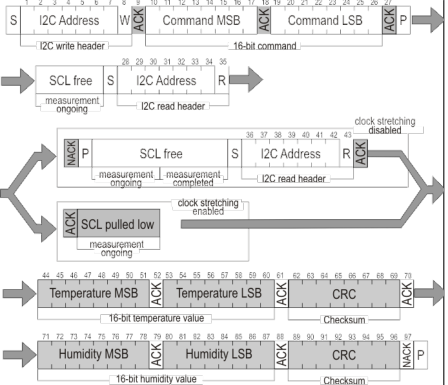
A measurement communication sequence consists of a START condition, the I2C write header (7-bit I2C device address plus 0 as the write bit) and a 16-bit measurement command. The proper reception of each byte is indicated by the sensor. It pulls the SDA pin low (ACK bit) after the falling edge of the 8th SCL clock to indicate the reception. A complete measurement cycle is depicted in Table 9.
The nReset pin may be used to generate a reset of the sensor. A minimum pulse duration of 1 µs is required to reliably trigger a reset of the sensor. Its function is explained in more detail in section 4. If not used it is recommended to leave the pin floating or to connect it to VDD with a series resistor of R ≥2 kΩ. However, the nRESET pin is internally connected to VDD with a pull up resistor of R = 50 kΩ (typ.).
With the acknowledgement of the measurement command, the SHT3x-DIS starts measuring humidity and temperature.
The sensor will send the temperature value first and then the relative humidity value. After having received the checksum for the humidity value a NACK and stop condition should be sent (see Table 9).
The repeatability setting influences the measurement duration and thus the overall energy consumption of the sensor. This is explained in section 2.
The I2C master can abort the read transfer with a NACK condition after any data byte if it is not interested in subsequent data, e.g. the CRC byte or the second measurement result, in order to save time.
Condition Hex. code
Repeatability Clock
stretching MSB LSB
In case the user needs humidity and temperature data but does not want to process CRC data, it is recommended to read the two temperature bytes of data with the CRC byte (without processing the CRC data); after having read the two humidity bytes, the read transfer can be aborted with a with a NACK.
High
Medium 0D
enabled 0x2C
Low 10
Medium 0B
disabled 0x24
Low 16
When a command without clock stretching has been issued, the sensor responds to a read header with a not acknowledge (NACK), if no data is present.
e.g. 0x2C06: high repeatability measurement with clock stretching enabled
When a command with clock stretching has been issued, the sensor responds to a read header with an ACK and subsequently pulls down the SCL line. The SCL line is pulled down until the measurement is complete. As soon as the measurement is complete, the sensor releases the SCL line and sends the measurement results.
In this mode one issued measurement command yields a stream of data pairs . Each data pair consists of one 16 bit temperature and one 16 bit humidity value (in this order).
Table 9 Measurement commands in single shot mode. The first “SCL free” block indicates a minimal waiting time of 1ms. (Clear blocks are controlled by the microcontroller, grey blocks by the sensor).
In periodic mode different measurement commands can be selected. The corresponding 16 bit commands are shown in Table 10. They differ with respect to repeatability (low, medium and high) and data acquisition frequency (0.5, 1, 2, 4 & 10 measurements per second, mps). Clock stretching cannot be selected in this mode.
The data acquisition frequency and the repeatability setting influences the measurement duration and the current consumption of the sensor. This is explained in section 2 of this datasheet.
Fetch Data 0x E0 00
Table 11 Fetch Data command (Clear blocks are controlled by the microcontroller, grey blocks by the sensor).
Medium 20
Low 2B
The ART (accelerated response time) feature can be activated by issuing the command in Table 12. After issuing the ART command the sensor will start acquiring data with a frequency of 4Hz.
Medium 22
Low 29
Medium 21
The ART command is structurally similar to any other command in Table 10. Hence section 4.5 applies for starting a measurement, section 4.6 for reading out data and section 4.8 for stopping the periodic data acquisition.
Low 2A
e.g. 0x2130: 1 high repeatability mps - measurement per second
The ART feature can also be evaluated using the Evaluation Kit EK-H5 from Sensirion.
W I2C Address
Command MSB
Command LSB
16-bit command I2C write header
Command Hex Code
Table 10 Measurement commands for periodic data acquisition mode (Clear blocks are controlled by the microcontroller, grey blocks by the sensor). N.B.: At the highest mps setting self-heating of the sensor might occur.
Periodic Measurement with
Transmission of the measurement data can be initiated through the fetch data command shown in Table 11. If no measurement data is present the I2C read header is responded with a NACK (Bit 9 in Table 11) and the communication stops. After the read out command fetch data has been issued, the data memory is cleared, i.e. no measurement data is present.
The periodic data acquisition mode can be stopped using the break command shown in Table 13. It is recommended to stop the periodic data acquisition prior to sending another command (except Fetch Data command) using the break command. Upon reception of the break command the sensor will abort the ongoing measurement and enter the single shot mode. This takes 1ms.
Break 0x3093
Table 13 Break command (Clear blocks are controlled by the microcontroller, grey blocks by the sensor).
Command Code
Address byte 0x00
Second byte 0x06
Reset command using the
general call address 0x0006
A system reset of the SHT3x-DIS can be generated externally by issuing a command (soft reset) or by sending a pulse to the dedicated reset pin (nReset pin). Additionally, a system reset is generated internally during power-up. During the reset procedure the sensor will not process commands.
General Call 1 st byte General Call 2 nd byte
Table 15 Reset through the general call address (Clear blocks are controlled by the microcontroller, grey blocks by the sensor).
In order to achieve a full reset of the sensor without removing the power supply, it is recommended to use the nRESET pin of the SHT3x-DIS.
If communication with the device is lost, the following signal sequence will reset the serial interface: While leaving SDA high, toggle SCL nine or more times. This must be followed by a Transmission Start sequence preceding the next command. This sequence resets the interface only. The status register preserves its content.
Pulling the nReset pin low (see Table 7) generates a reset similar to a hard reset. The nReset pin is internally connected to VDD through a pull-up resistor and hence active low. The nReset pin has to be pulled low for a minimum of 1 µs to generate a reset of the sensor.
A hard reset is achieved by switching the supply voltage to the VDD Pin off and then on again. In order to prevent powering the sensor over the ESD diodes, the voltage to pins 1 (SDA), 4 (SCL) and 2 (ADDR) also needs to be removed.
The SHT3x-DIS provides a soft reset mechanism that forces the system into a well-defined state without removing the power supply. When the system is in idle state the soft reset command can be sent to the SHT3x- DIS. This triggers the sensor to reset its system controller and reloads calibration data from the memory. In order to start the soft reset procedure the command as shown in Table 14 should be sent.
The SHT3x is equipped with an internal heater, which is meant for plausibility checking only. The temperature increase achieved by the heater depends on various parameters and lies in the range of a few degrees centigrade. It can be switched on and off by command, see table below. The status is listed in the status register. After a reset the heater is disabled (default condition).
It is worth noting that the sensor reloads calibration data prior to every measurement by default.
Soft Reset 0x30A2
Table 14 Soft reset command (Clear blocks are controlled by the microcontroller, grey blocks by the sensor).
15 Alert pending status '0': no pending alerts '1': at least one pending alert
Heater Disabled 66
13 Heater status ‘0’ : Heater OFF ‘1’ : Heater ON
11 RH tracking alert ‘0’ : no alert ‘1’ . alert
10 T tracking alert ‘0’ : no alert ‘1’ . alert
‘0’
'0': no reset detected since last ‘clear status register’ command
'1': reset detected (hard reset, soft reset command or supply fail)
Command Hex code
1 Command status '0': last command executed successfully '1': last command not processed. It was either invalid, failed the integrated command checksum
0 Write data checksum status '0': checksum of last write transfer was correct '1': checksum of last write transfer failed
Table 17 Command to read out the status register (Clear blocks are controlled by the microcontroller, grey blocks by the sensor).
Table 18 Description of the status register.
All flags (Bit 15, 11, 10, 4) in the status register can be cleared (set to zero) by sending the command shown in Table 19.
Clear status register 0x 30 41
Table 19 Command to clear the status register (Clear blocks are controlled by the microcontroller, grey blocks by the sensor).
Property Value
Relative humidity conversion formula (result in %RH):
Name CRC-8
Width 8 bit
Protected data read and/or write data
Temperature conversion formula (result in °C & °F):
Polynomial 0x31 (x 8 + x 5 + x 4 + 1)
Initialization 0xFF
Reflect input False
Reflect output False
1
Final XOR 0x00
Examples CRC (0xBEEF) = 0x92
S RH and S T denote the raw sensor output for humidity and temperature, respectively. The formulas work only correctly when S RH and S T are used in decimal representation.
Table 20 I2C CRC properties.
| -40 -20 | 0 | 20 | 40 | 60 | 80 | 100 | 120 | -40 -20 | 0 | 20 | 40 | 60 | 80 | 100 | 120 |
|---|---|---|---|---|---|---|---|---|---|---|---|---|---|---|---|
| Temperature (°C) | Temperature (°C) | ||||||||||||||
| Figure 8 Temperature accuracy of the SHT30 sensor. | Figure 9 Temperature accuracy of the SHT31 sensor. |
| Parameter | Symbol | Condition | Min. | Typ. | Max. | Units Comments |
|---|---|---|---|---|---|---|
| Supply voltage | V | 2.15 | 3.3 | 5.5 | V |
| V and V | , |
|---|---|
| DD,min | DD max |
| (periodic data | - | 45 | - | A measurement during |
|---|---|---|---|---|
| acquisition mode) | periodic data acquisition |
| Duration of reset pulse | t RESETN | 1 | - | - | µs See section 3.6 | |
|---|---|---|---|---|---|---|
| t MEAS,l | Low repeatability | - | 2.5 | 4 | ms The three repeatability modes |
| Parameter | Rating | Units | |
|---|---|---|---|
| Supply voltage V | DD | -0.3 to 6 | V |
| Max Voltage on pins (pin 1 (SDA); pin 2 (ADDR); pin 3 (ALERT); pin 4 (SCL); pin 6 | -0.3 to VDD+0.3 | V |
| Input current on any pin | ±100 | mA | |
|---|---|---|---|
| Operating temperature range | -40 to 125 | °C | |
| Storage temperature range | -40 to 150 | °C | |
| ESD HBM (human body model) | 9 | 4 | kV |
| ESD CDM (charge device model) | 10 | 750 | V |
| 5 | VDD | Supply voltage; input | recommended to wire the sensor according to the |
|---|---|---|---|
| Reset pin active low; input; if not used it | application circuit as shown in Figure 11. |
| No electrical function; to be connected | R | R | ||
|---|---|---|---|---|
| 7 | R | P | P |
| frequencies up to 1000 kHz). Clock stretching can be | triggers the acquisition of | one data pair | . Each data pair | |
|---|---|---|---|---|
| enabled and disabled through the appropriate user | consists of one 16 bit temperature and one 16 bit | |||
| command. For detailed information on the I2C protocol, | humidity value (in this order). During transmission each | |||
| refer to NXP I2C-bus specification | 12 . | data value is always followed by a CRC checksum, see |
| 4.4 | Readout of Measurement Results for | acquisition frequency (0.5, 1, 2, 4 & 10 measurements |
|---|---|---|
| Single Shot Mode | per second, mps). Clock stretching cannot be selected in |
| Repeatability | mps | MSB | LSB |
|---|---|---|---|
| High | 32 | ||
| Medium | 0.5 | 0x20 | 24 |
| Low | 2F | ||
| High | 30 | ||
| Medium | 1 | 0x21 | 26 |
| Low | 2D | ||
| High | 36 |
| S I2C Address | W ACK Command MSB | ACK Command LSB | ACK |
|---|---|---|---|
| I2C write header | 16-bit command |
| externally by issuing a command (soft reset) or by | 1 2 3 4 5 6 7 8 9 1 2 3 4 5 6 7 8 9 |
|---|---|
| sending a pulse to the dedicated reset pin (nReset pin). | S General Call Address ACK Reset Command ACK |
| MSB | LSB | value | |||
|---|---|---|---|---|---|
| Heater Enable | 6D | 15 | Alert pending status | ‘1’ |
| 14 | Reserved | ‘0’ |
|---|---|---|
| 13 | Heater status | ‘0’ |
| Table 16 | Heater command (Clear blocks are controlled by | 12 | Reserved | ‘0’ |
|---|---|---|---|---|
| the microcontroller, grey blocks by the sensor). | 11 | RH tracking alert | ‘0 |
| the execution status of the last command and the last | 9:5 Reserved | ‘xxxxx’ |
|---|---|---|
| write sequence. The command to read out the status | 4 | ‘1’ |
| 3:2 Reserved | ‘00’ |
|---|---|
| 1 Command status | ‘0’ |
| S and S | denote the raw sensor output for humidity |
|---|---|
| RH | T |
Measurement data is always transferred as 16-bit values (unsigned integer). These values are already linearized
Hold time (repeated) START condition t HD;STA After this period, the first clock pulse is generated 0.24 - - µs
LOW period of the SCL clock t LOW 0.53 - - µs
HIGH period of the SCL clock t HIGH 0.26 - - µs
SDA hold time t HD;DAT 0 - 250 ns Transmitting data
Set-up time for a repeated START condition t SU;STA 0.26 - - µs
Set-up time for STOP condition t SU;STO 0.26 - - µs
t HD;DAT
t SU;DAT
t R
t F
t VD;DAT
Figure 12 Timing diagram for digital input/output pads. SDA directions are seen from the sensor. Bold SDA lines are controlled by the sensor, plain SDA lines are controlled by the micro-controller. Note that SDA valid read time is triggered by falling edge of preceding toggle.
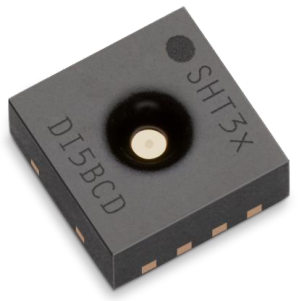
SHT3x-DIS sensors are provided in an open-cavity DFN package. DFN stands for dual flat no leads. The humidity sensor opening is centered on the top side of the package.
The bottom line consists of 6 letters. The first two digits XY (=DI) describe the output mode. The third letter (A) represents the manufacturing year (4 = 2014, 5 = 2015, etc). The last three digits (BCD) represent an alphanumeric tracking code. That code can be decoded by Sensirion only and allows for tracking on batch level through production, calibration and testing – and will be provided upon justified request.
The sensor chip is made of silicon and is mounted to a lead frame. The latter is made of Cu plated with Ni/Pd/Au. Chip and lead frame are overmolded by an epoxy-based mold compound leaving the central die pad and I/O pins exposed for mechanical and electrical connection. Please note that the side walls of the sensor are diced and therefore these diced lead frame surfaces are not covered with the respective plating.
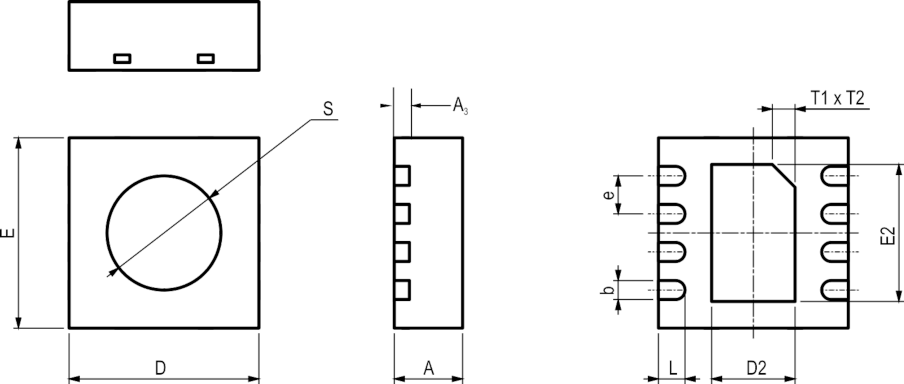
If viewed from below pin 1 is indicated by triangular shaped cut in the otherwise rectangular die pad. The dimensions of the triangular cut are shown in Figure 14 through the labels T1 & T2.
The package (except for the humidity sensor opening) follows JEDEC publication 95, design registration 4.20, small scale plastic quad and dual inline, square and rectangular, No-LEAD packages (with optional thermal enhancements) small scale (QFN/SON), Issue D.01, September 2009.
SHT3 x
SHT3x-DIS has a Moisture Sensitivity Level (MSL) of 1, according to IPC/JEDEC J-STD-020. At the same time, it is recommended to further process the sensors within 1 year after date of delivery.
All SHT3x-DIS sensors are laser marked for easy identification and traceability. The marking on the sensor top side consists of a pin-1 indicator and two lines of text.
Figure 13 Top view of the SHT3x-DIS illustrating the laser marking.
Max cavity
including displacement tolerances. Typically the opening
will be smaller.
Center pad marking T1xT2 - 0.3x45° - mm indicates the position of pin 1
Table 22 Package outline.
For solder paste printing it is recommended to use a laser-cut, stainless steel stencil with electro-polished trapezoidal walls and with 0.1 or 0.125 mm stencil thickness. The length of the stencil apertures for the I/O pads should be the same as the PCB pads. However, the position of the stencil apertures should have an offset of 0.1 mm away from the center of the package. The die pad aperture should cover about 70 – 90 % of the die pad area –thus it should have a size of about 0.9 mm x 1.6 mm.
Figure 15 shows the land pattern. The land pattern is understood to be the open metal areas on the PCB, onto which the DFN pads are soldered.
Recommended Land Pattern Recommended Stencil Aperture
Figure 15 Recommended metal land pattern (left) and stencil apertures (right) for SHT3x-DIS. The dashed lines represent the outer dimension of the DFN package. The PCB pads (left) and stencil apertures (right) are indicated through the shaded areas.
2.00 ±.05 SEE Note 2
NOTES: 1. 10 SPROCKET HOLE PITCH CUMULATIVE TOLERANCE ±0.2 2. POCKET POSITION RELATIVE TO SPROCKET HOLE MEASURED AS TRUE POSITION OF POCKET, NOT POCKET HOLE 3. A0 AND B0 ARE CALCULATED ON A PLANE AT A DISTANCE "R" ABOVE THE BOTTOM OF THE POCKET
Figure 16 Technical drawing of the packaging tape with sensor orientation in tape. Header tape is to the right and trailer tape to the left on this drawing. Dimensions are given in millimeters.
Qualification of the SHT3x-DIS is performed based on the JEDEC JESD47 qualification test method.
Name Quantity Order Number
SHT30-DIS-B2.5kS 2500 1-101400-01
| Parameter | Symbol | Conditions | Min. | Typ. | Max. | Units | Comments | |
|---|---|---|---|---|---|---|---|---|
| SCL clock frequency | f SCL | 0 | - | 1000 | kHz |
| 0 | - | - | ns | Receiving data | ||
|---|---|---|---|---|---|---|
| SDA set-up time | t SU;DAT | 100 | - | - | ns | |
| SCL/SDA rise time | t | - | - | 300 | ns |
| SCL/SDA fall time | t F | - | - | 300 | ns |
|---|---|---|---|---|---|
| SDA valid time | t VD;DAT | - | - | 0.9 | µs |
| Capacitive load on bus line | CB | - | - 400 | pF | |||
|---|---|---|---|---|---|---|---|
| Low level input voltage | V | 0 | - 0.3xV | V | |||
| IL | DD | ||||||
| High level input voltage | V IH | 0.7xV DD | - 1xV DD | V | |||
| Low level output voltage | V OL | 3 mA sink current | - | - 0.4 | V | ||
| Table 21 | Timing specifications for I2C communication, valid for T=-40°C … 125°C and VDD = VDD | min … VDD | max . The nomenclature |
| t | t | t | t |
|---|---|---|---|
| HIGH | LOW | R | F |
| Parameter | Symbol | Min | Nom. | Max | Units Comments | |
|---|---|---|---|---|---|---|
| Package height | A | 0.8 | 0.9 | 1 | mm | |
| Leadframe height | A3 | - | 0.2 | - | mm | |
| Pad width | b | 0.2 | 0.25 | 0.3 | mm | |
| Package width | D | 2.4 | 2.5 | 2.6 | mm | |
| Center pad length | D2 | 1 | 1.1 | 1.2 | mm | |
| Package length | E | 2.4 | 2.5 | 2.6 | mm | |
| Center pad width | E2 | 1.7 | 1.8 | 1.9 | mm | |
| Pad pitch | e | - | 0.5 | mm | ||
| Pad length | L | 0.25 | 0.35 | 0.45 | mm | |
| S | - | - | 1.5 | mm | Only as guidance. This value includes all tolerances, |
| SHT30-DIS-B10kS | 10000 | 1-101173-01 | |
|---|---|---|---|
| The device is fully RoHS and WEEE compliant, e.g. | SHT31-DIS-B2.5kS | 2500 | 1-101386-01 |
| free of Pb, Cd, and Hg. | SHT31-DIS-B10kS | 10000 | 1-101147-01 |
| SHT35-DIS-B2.5kS | 2500 | 1-101388-01 |
SHT35-DIS-B10kS 10000 1-101479-01
The SHT3x-DIS can be ordered in tape and reel packaging with different sizes, see Table 23. The reels are sealed into antistatic ESD bags. The document “SHT3x shipping package” that shows the
Table 23 SHT3x-DIS ordering options.